

Most content calendars are built around a number: four posts a month, two a week, something that can be counted and reported. The number is easy to defend in a meeting and it produces a steady output of work that almost nobody sees.
The alternative is unglamorous and harder to schedule. Write fewer posts, make one of them genuinely good, and then do the part that most publishing workflows skip entirely, which is putting it in front of people more than once and in more than one place.
Why One Post Deserves Six Placements
A published post is not distributed. It is available. Those are different states, and conflating them is why so much decent writing gets a spike on the day it goes live and nothing afterwards.
The practice has a name in agency work, content repurposing, though the name undersells it. Done properly it is not recycling a post after the fact but planning the placements before the first draft, so the structure of the piece can serve all of them. Agencies that treat it as a workflow rather than an afterthought, among them https://mehrana.agency/, decide at the outline stage which sections will become the email, which will become the social version, and which exist to be quoted.
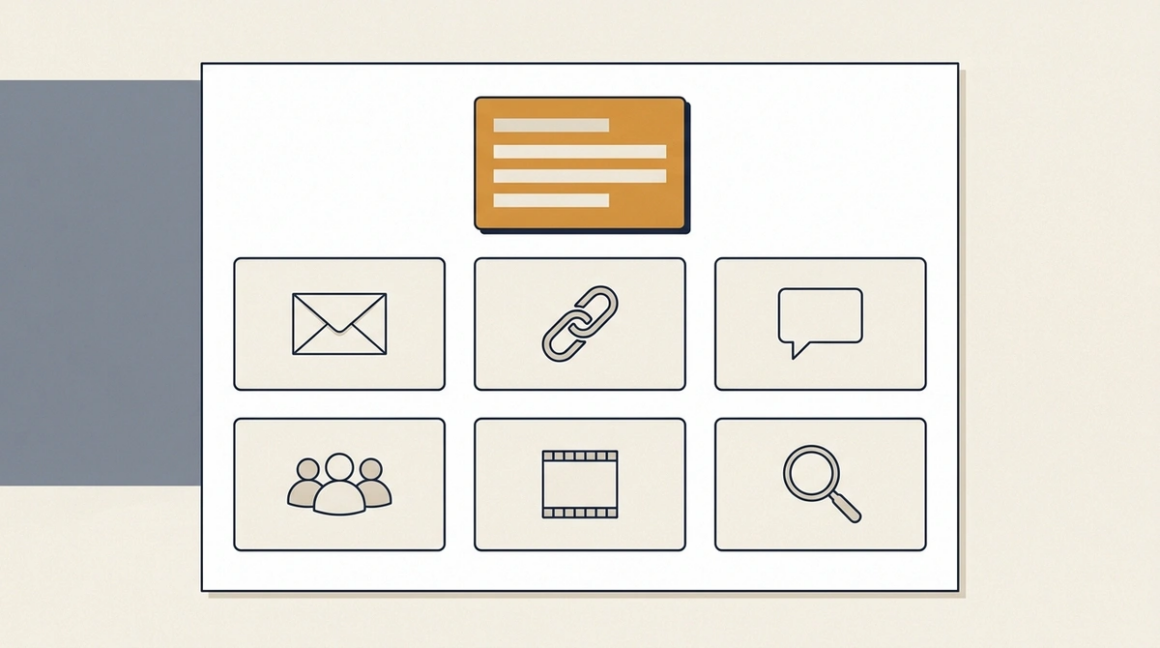
What follows is six placements for one post, in the order they are worth doing.

1. Start With the Email List You Already Own
The list is the only audience nobody can take away, and it is the placement most often skipped because it feels redundant to tell people about something already on the site.
It is not redundant. A post sent to a list reaches people who would never have returned to the site on their own, and it arrives in a channel with no algorithm deciding whether to show it. The version that works is not a link with a sentence above it. It is the argument of the post, compressed to its useful core, with the link for anyone who wants the full version.
Two details matter more than the copy. Send it once to everyone, then once more a few days later to the people who did not open the first one, with a different subject line. And do not save the send for the day of publication if that day is arbitrary, which it usually is.
2. Internal Linking That Makes the Post Findable
The second placement is on your own site, and it is the one with the longest tail.
A new post that nothing links to is reachable only from the blog index, which means it accumulates nothing. Link to it from the two or three existing pages that are genuinely about the same thing, in the body text, rather than in a closing list of related reading. Then link out from the new post to the pages you want people to reach next.
This takes ten minutes, compounds, and is the single most underused distribution channel on most sites, mostly because it does not feel like distribution.
3. Structure the Post So AI Search Can Quote It
The third placement is not a channel you post to. It is a format decision that determines whether assistants can use the piece at all.
Content that gets quoted in AI-generated answers tends to share a shape: a direct answer near the top rather than four paragraphs of preamble, headings that state claims instead of teasing them, specific figures and named examples rather than hedged generalities, and definitions that stand alone when lifted out of context.
None of that requires writing for machines at the expense of readers. It is the same structure that serves a skimming human, which is most of them.
4. Rewrite It Native for Each Social Platform
The fourth placement is where most effort gets wasted, because the default behaviour is posting the same link with the same sentence to four platforms.
The version that works carries the idea itself, not a referral to it. One argument from the post, written in that platform’s register, complete enough to be worth reading without clicking. Some readers will click and most will not, and the ones who do not still encountered the thinking, which is the part that builds any sort of recognition over time.
Posting the same text everywhere performs worse than posting to one platform properly.
5. Place It in Someone Else’s Newsletter or Community
The fifth placement is other people’s audiences, and it is the one with the highest ceiling.
This means relevant newsletters, forums and communities where the topic is already being discussed, and publications that take contributed pieces. The rule that makes it work is that the contribution has to stand on its own merit for that audience. A piece submitted as a vehicle for a link gets rejected, and should.
Start with the smallest, most specific venue rather than the largest. A niche newsletter with two thousand engaged subscribers routinely outperforms a general publication with fifty thousand indifferent ones.
6. Convert It Into a Second Medium
The sixth placement takes the longest and reaches the audience the other five miss entirely.
A post becomes a short video, an audio segment, a slide sequence, or a single well-made diagram. The conversion is not mechanical. What survives the move to another medium is usually the one clear idea, which is also a useful test of whether the post had one.
Pick the medium by where the audience already is rather than by what is easiest to produce. For a technical readership that often means a diagram, which costs an afternoon and gets reused by other people for years. For a consumer audience it usually means video, which costs considerably more and has a much shorter half-life.
Six placements is also roughly the point of diminishing returns. A seventh rarely earns its time.
What to Automate and What to Keep Manual
Automation belongs in the mechanical parts of this and nowhere else.
Scheduling, reminders, cross-posting the already-written native versions, pulling the links into a tracking sheet, flagging posts that never got their internal links: all worth automating, and all boring enough that automation is the only reason they get done consistently.
What does not survive automation is the writing of each version. A tool that rewrites a post for six channels produces six versions of the same flat text, and readers can tell. The useful split is that automation handles when and where, while a person still handles what it says.
As for measurement, the honest answer is that attributing results across six placements is harder than any dashboard admits. The workable substitute is to track two things: whether branded searches for your name increase over a quarter, and whether people arrive already knowing what you do. Both are slow signals. Both are better evidence than a traffic spike on publication day.