
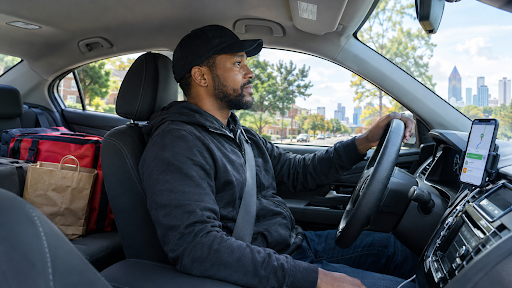
It’s a Tuesday night, you’ve got the Uber Driver app open in Midtown, and no ride has come in yet. A car changes lanes into you on the Downtown Connector. Is the accident covered by Uber, by your personal policy, or by nobody?
The honest answer depends on what the app was doing at that exact moment. Georgia’s rules split a rideshare trip into stages, delivery apps work differently, and the damage to your own car is a separate problem from the injuries you cause. Here’s how it breaks down and where the gaps sit.
How Georgia divides a rideshare trip
Georgia’s rideshare insurance statute sets coverage by stage, and the amounts change as the trip progresses.
When you’re logged in and waiting for a request, the company’s coverage is contingent, meaning it’s meant to apply only if your own policy doesn’t. The limits are $50,000 per person and $100,000 per accident for injuries, plus coverage for property damage. Sources I found disagree on the exact property damage figure, so check the current statute or ask Uber for the number in writing.
Once you accept a ride request and while a passenger is in the car, the required liability coverage rises to $1 million. In those stages, the company’s insurance is primary.
One change matters if you drive often. Georgia used to require rideshare companies to carry $1 million in uninsured and underinsured motorist coverage for passengers and drivers, and in July 2023 it dropped to $100,000 per person and $300,000 per accident, according to attorney summaries of HB 529. If a driver with no insurance hits you with a passenger on board, that’s the number you’re relying on.
Delivery isn’t rideshare
If you drive for DoorDash, a common assumption is that the same rules apply. They don’t. The Georgia statute covers transportation network companies, which arrange rides for passengers. Delivery platforms fall outside that definition, so there’s no state-set minimum for a Dasher in the same way.
What you get depends on the platform’s own program. DoorDash states on its Dasher insurance page that its liability coverage may pay up to $1,000,000 for injuries or property damage to other people in most states, from the time you accept an offer until you drop off the order. That coverage may apply as excess, which means it sits on top of your own insurance. DoorDash also says it doesn’t require special insurance beyond a valid personal auto policy.
The part to read closely is the gap between orders. With the app on and no order accepted, the platform’s liability coverage in many states doesn’t apply, and your personal policy may not either. DoorDash’s help center lists state-specific details, so find Georgia’s entry before you rely on any of this.
The damage to your own car
Every platform’s liability coverage pays other people. Fixing your car is a different question, and the answers are less generous.
Platforms generally offer contingent collision and comprehensive coverage during active trips, but only if you already carry collision and comprehensive on your own policy, and a deductible applies. If you carry only the state minimum, there’s nothing for the platform’s coverage to attach to, and a wrecked car is your cost. Between rides or orders, there’s typically no platform coverage for your vehicle at all.
This matters for drivers with older, paid-off cars who dropped collisions to save money. That choice looks reasonable until you’re working in a car you can’t afford to replace.
What your personal policy may do
Many personal auto policies exclude driving for hire, or at least limit it. If you have an accident while the app is on and your insurer finds out you never disclosed the work, it can deny the claim, and in some cases cancel the policy. A Georgia law firm notes that in some situations the platform’s Period 1 coverage is supposed to step in when your insurer denies the claim, but you don’t want a dispute as your plan.
The fix is to tell your insurer what you do. That conversation can lead to a rideshare endorsement, which adds coverage for the stages where the app is on and you’re waiting. Georgia law lets a driver satisfy part of the coverage requirement through such an endorsement.
Options to fill the gaps
You have a few ways to close the gaps, each with trade-offs:
- A rideshare or delivery endorsement on your personal policy. It usually costs less than a separate policy and covers the waiting period. Check whether it covers delivery as well as passengers, since some endorsements only apply to rideshare.
- A commercial or hybrid policy. It covers business use fully, with higher limits, and costs more. It makes sense if you drive full time.
- Higher liability limits or an umbrella policy. This helps if you worry about a serious injury claim, though your insurer has to be told about the work.
- Collision and comprehensive. If you lease or finance the car, you probably need these anyway. If you own it outright, compare the premium to what the car is worth.
Ask each carrier you quote for car insurance in Atlanta, GA whether it sells a rideshare or delivery endorsement, and get the answer in writing, including the price and what stages it covers. Compare quotes at the same limits and the same deductible, since a lower price may only reflect lower coverage.
A higher deductible lowers the premium, and it backfires if a $2,500 repair bill would force you to stop driving for a week.
The floor under all of it
Georgia requires 25/50/25 liability, meaning $25,000 for one person’s injuries, $50,000 for all injuries in a crash, and $25,000 for property damage. The car insurance Georgia requires is the base that your rideshare or delivery work sits on, and it’s the coverage that applies when no platform program does. Those limits are low for a driver who spends hours a day on I-285 and the Connector.
Also ask about uninsured motorist coverage. If you carry passengers or take orders at night, a driver with no insurance is one of the more likely ways a bad crash turns into your problem.
If you’re in a crash
The first minutes decide how the claim goes, so keep a short list in your head:
- Check for injuries, call 911, and get a police report.
- Screenshot your app status immediately. It shows whether you were waiting, en route, or carrying a passenger or order.
- Photograph the cars, the scene, and the other driver’s plate and insurance.
- Report the crash to the platform and to your own insurer promptly.
- Don’t admit fault or discuss coverage at the scene.
Keep trip logs and earnings records. They show which stage you were in and how much of your driving is for work.
Before your next shift
Call your insurer and ask three plain questions: what happens if I have an accident with the app on, does my policy exclude business use, and can I add an endorsement? Then read the platform’s insurance page for Georgia. It’s a short conversation, and it tells you whether you’re covered before the day you find out the hard way.